
Palm Coast Local
Locals Helping Locals
Sammy the Sea Turtle - Your Local Search Buddy
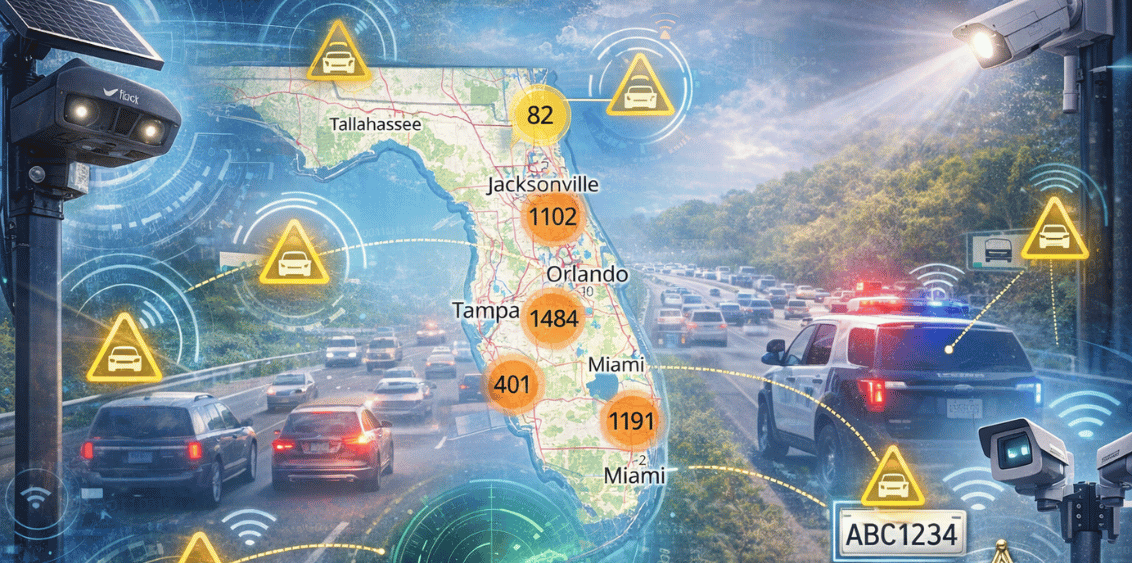
A visual map of Florida highlighting the distribution of automated license plate reader (ALPR) cameras, including Flock Safety systems, with clustered markers across major cities such as Jacksonville, Orlando, Tampa, and Miami. The image includes overlay graphics representing surveillance cameras, vehicle tracking, traffic flow, and law enforcement activity, illustrating the widespread presence of ALPR technology across the state.
Map visualization showing the concentration of ALPR and Flock camera systems across Florida, illustrating their presence along major travel corridors and populated areas.

Do We Have Flock Cameras in Palm Coast and Flagler County? Yes! 

Do We Have Flock Cameras in Palm Coast and Flagler County?

YES — Let’s Start With What They Are and How They Work

Before identifying where these systems are located locally, it is important to understand what people are referring to when they say “Flock Cameras” or “ALPR systems.”

What Are Flock Cameras?

Flock Cameras are a specific brand of Automated License Plate Reader (ALPR) technology developed by Flock Safety. These systems are typically mounted on poles or integrated into roadside infrastructure and are designed to capture and catalog vehicle movement.

They are commonly used by law enforcement agencies, private communities, and commercial properties.


What Is ALPR (Automatic License Plate Recognition)?

A surveillance camera known to be part of an automatic license plate recognition (ALPR) system utilizes computer vision technology to scan images of vehicular traffic for license plates and identifying vehicle characteristics such as color, make, and model. This information is typically stored in databases and used in law enforcement scenarios, including vehicle theft and investigations.

In simple terms, these systems do not just take images, they analyze, categorize, and store vehicle movement data.


How ALPR and Flock Cameras Collect Data

When a vehicle passes one of these cameras, several things occur:

  • Image capture using high-resolution and often infrared-enabled cameras
  • License plate recognition using computer vision
  • Vehicle identification including color, make, and distinguishing features
  • Time and location tagging for each recorded event
  • Data storage in searchable databases


Important Distinction

These systems are not red-light or speed enforcement cameras. They do not issue tickets. Their primary purpose is data collection for investigative and tracking use.


How Widespread Are These Cameras in Florida?

Across Florida, ALPR systems have expanded rapidly.

According to Banish Big Brother:

  • More than 6,054 license plate reader cameras are mapped within the State of Florida as of March 2026.

While this number provides strong context, it is important to note that publicly available maps are often community-driven and may not reflect every installation or official record.

What is clear is that these systems are not isolated, they are part of a broader, statewide presence.
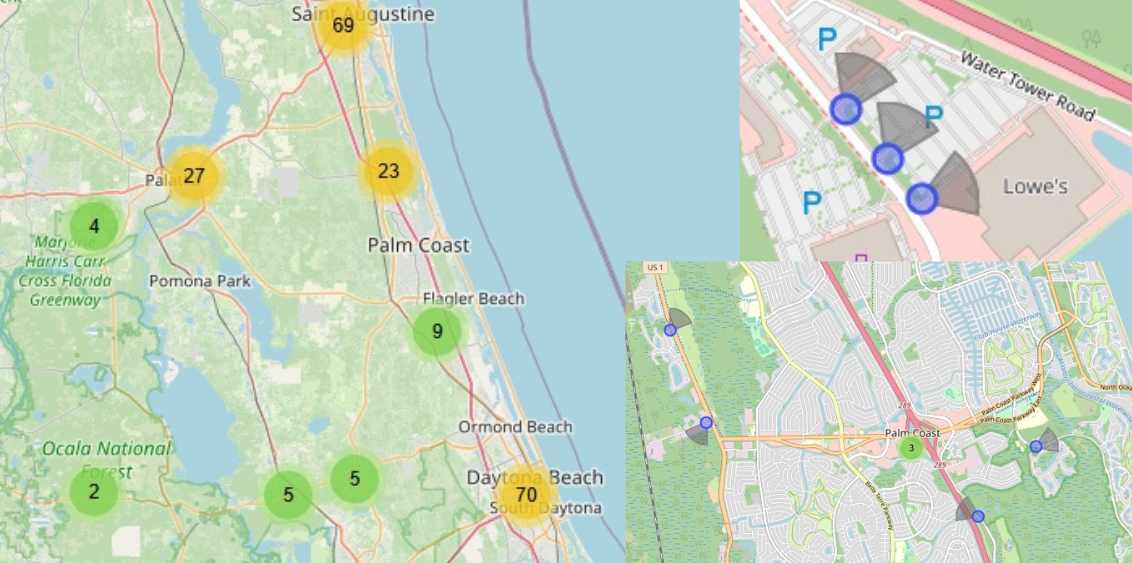

Observed ALPR / Flock Camera Locations (Palm Coast Area and Surrounding Corridors)


Flock & ALPR Camera Locations by Map in Flagler County Florida.

The following locations are based on observed data and publicly available tagging. These entries reflect systems consistent with ALPR technology and, where identified, specific manufacturers or operators.

Lowes Parking Lot

  • Surveillance: Cameras ×3
  • Type: ALPR
  • Structure: Man-Made — Hidden in Landscape
  • Visibility: Blends into surroundings; not easily recognized


Colbert Lane (Just Past Daytona State College Campus)

  • Surveillance: Fixed Camera System (Pole-Mounted)
  • Type: ALPR
  • Manufacturer: Flock Safety
  • Placement: Public Traffic Zone
  • Direction: ~67°


Old Kings Rd South (Next to Graham Swamp Trail)

  • Surveillance: Fixed Camera System
  • Type: ALPR
  • Manufacturer: Flock Safety
  • Placement: Public Traffic Zone
  • Direction: ~295°


Hargrove Grade Entrance (Across from Flagler Humane Society)

  • Surveillance: Fixed Camera System
  • Type: ALPR
  • Manufacturer: Flock Safety
  • Placement: Public Traffic Zone
  • Direction: ~213°


Between US-1 and Jackson Blue Drive (Landscape Placement)

  • Surveillance: Fixed Camera System
  • Type: ALPR
  • Manufacturer: Flock Safety
  • Placement: Traffic Corridor
  • Direction: ~35°
  • Visibility: Low visibility, blended into landscape


I-95 North Exit Ramp & Moody Blvd (From South Florida — Near Burger King)

  • Surveillance: Fixed Camera System
  • Type: ALPR
  • Manufacturer: Flock Safety
  • Placement: High-Volume Exit Ramp
  • Direction: ~61°


US-1 & CR 302 (Heading Toward Bunnell)

  • Surveillance: Multi-Camera Node (3 Cameras)
  • Type: ALPR
  • Manufacturer: Rekor Systems
  • Placement: Public Intersection
  • Direction: Multi-directional (~84°, 198°, 320°)


Belle Terre Pkwy & Citation Blvd (Near Water Treatment Plant #2)

  • Surveillance: Fixed Camera System
  • Type: ALPR
  • Manufacturer: Flock Safety
  • Placement: Public Intersection
  • Direction: ~90°


Seminole Woods Blvd & US-1 (Near Squash Blossom Trail)

  • Surveillance: Fixed Camera System
  • Type: ALPR
  • Manufacturer: Flock Safety
  • Placement: Public Intersection
  • Direction: ~29°


South Old Dixie Hwy & US-1 (Near CR 2002 & CR 325 Turn-About)

  • Surveillance: Fixed Camera System
  • Type: ALPR
  • Manufacturer: Flock Safety
  • Placement: Public Intersection
  • Direction: ~87°


Old Dixie Hwy (Just Past I-95 Ramp — Across from 7-Eleven & Truist Bank)

  • Surveillance: Fixed Camera System
  • Type: ALPR
  • Manufacturer: Flock Safety
  • Operator: Volusia County Sheriff’s Office
  • Placement: Public Traffic Zone
  • Direction: ~227°–272°


I-95 Northbound (Near Pellicer Creek — St. Johns County Line)

  • Surveillance: Fixed Camera System
  • Type: ALPR
  • Manufacturer: Flock Safety
  • Operator: St. Johns County Sheriff’s Office
  • Placement: Interstate Corridor
  • Direction: ~315°


What These Locations Suggest

Based on observed placement:

  • Systems are positioned along major corridors such as US-1, I-95, and Belle Terre Parkway
  • Cameras appear at entry and exit points, intersections, and transition routes
  • Some are highly visible, while others are integrated into landscaping
  • Multiple agencies and systems operate across connected regions

These observations reflect placement patterns aligned with traffic movement.


Frequently Asked Questions About ALPR & Flock Cameras

Who Has Access to the Data?

Access depends on the operator. Law enforcement agencies typically access data from systems they operate or partner with. Private systems may also share data with law enforcement. Access is restricted to authorized users.


How Long Is the Information Stored?

Data retention varies by system and operator. Some systems are commonly reported to retain data for limited periods, often around 30 days, though policies can differ.


Where Are These Systems Located and Why?

These systems are typically placed along:

  • Major roadways
  • Interstate access points
  • Intersections and connector roads
  • Entry and exit routes

Their placement aligns with areas where traffic flows, merges, or changes direction.


A Broader Conversation Is Emerging Nationwide

A growing number of U.S. cities are reevaluating the use of ALPR systems.

Flock Safety, an Atlanta-based company valued at approximately $7.5 billion and backed by Andreessen Horowitz, developed these systems to assist law enforcement in identifying vehicles associated with criminal activity.

However, the same capabilities have raised concerns among privacy advocates and local governments, particularly regarding how data is accessed and shared.

In recent months, dozens of cities have rejected or discontinued use of these systems, contributing to a broader national conversation about artificial intelligence, surveillance, and data use.


Closing Perspective

With thousands of ALPR cameras mapped across Florida, the systems observed in Palm Coast, Flagler County, and surrounding areas are part of a broader and expanding infrastructure.

This article presents a factual, location-based view as of March 2026, allowing residents to better understand what is present locally and how it fits into a larger statewide and national landscape. 


Add comment

I confirm my comment does not contain hate speech, harassment, false or defamatory statements about any person, business or political figure. I understand my comment are moderated and may be removed if they violate platform guideline.

Guest

Your rating:

Security code Refresh

Submit